

About the AI chat
The Base44 AI chat is more than just a code generator. It works as your intelligent assistant, understands your goal, and uses the right tools to get you there. Your apps become more accurate, context-aware, and flexible, so you can focus on building complex features quickly, with smart automation working in the background. Unlike traditional AI that only responds with text, the agentic AI knows when to search the web, check your files, or pull in data from other sources. It also uses automatic model selection to choose state-of-the-art models based on what your prompt needs, so you get real solutions without needing to manage models or technical details yourself.What does this mean in practice? Here are some examples:
- Share a public website link with the chat to instantly copy the design, layout, and visible content into your app. For example: “Copy the layout from
https://example.com.” - Ask the agent to help you follow best practices by searching for ready-made code or common solutions. For example: “Show me the standard pattern for user authentication.”
- Pull lists or content from other websites and use it in your app, such as importing product catalogs or gathering site text and images. For example: “Import the product list from
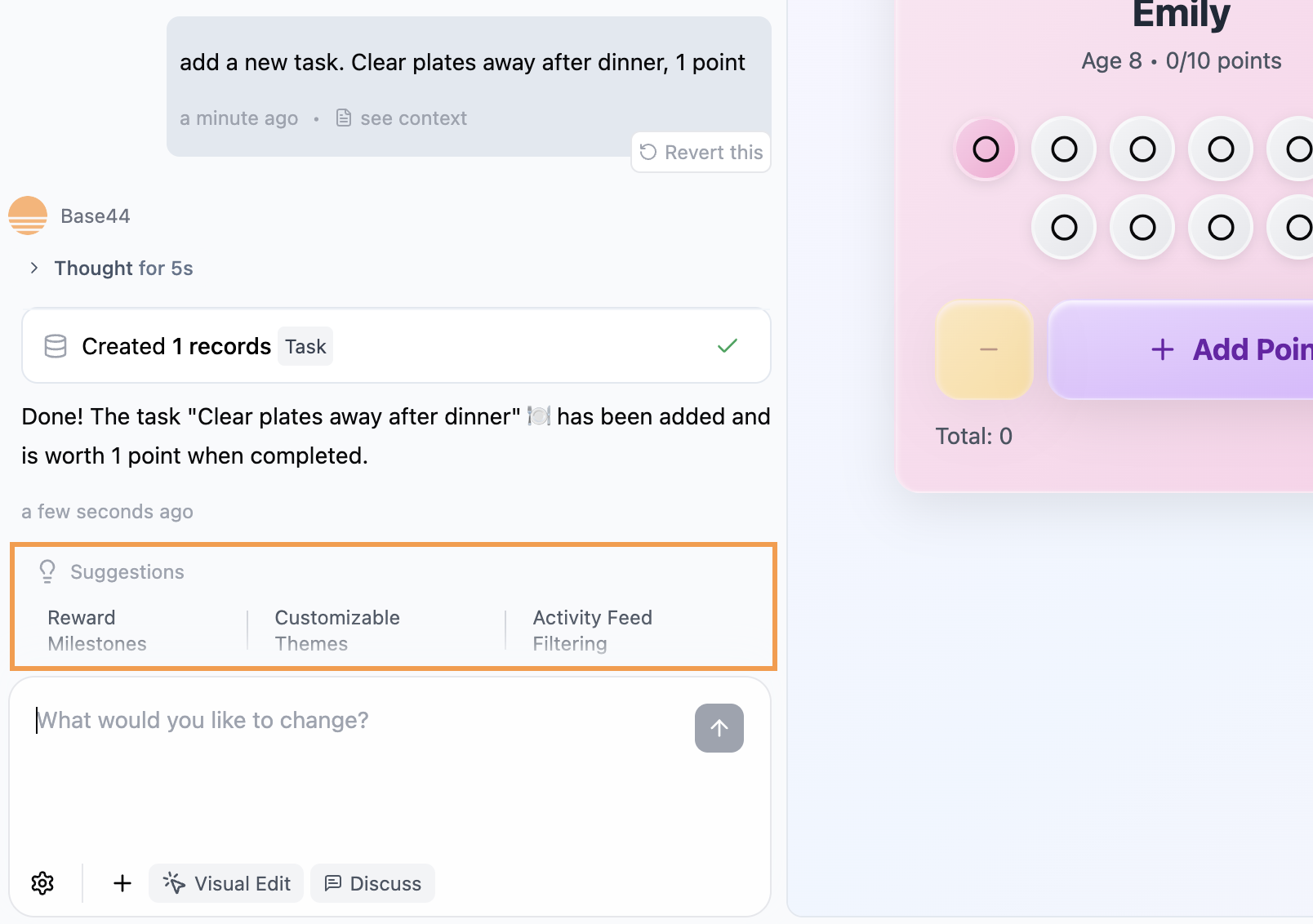
https://example.com.” - Directly update your app’s database with simple, clear instructions. For example: “Give Emily a point for doing her homework.”
Using the AI chat modes
Base44’s AI app builder includes 3 chat modes for building your app:- Default: Acts instantly on your prompts.
- Discuss: Lets you plan and refine ideas safely before applying changes.
- Edit: Lets you click elements in your preview to adjust visuals directly.
Default mode
Type what you need, and the AI acts right away. This mode is perfect for quick edits and feature requests. To get the best results, be as specific as possible. The more detail you give, the more precisely the AI builds your app.For example: Ask the AI to create a new page to your app.

Using the default chat mode to edit your app
Discuss mode
Click Discuss in the AI chat to have a conversation with the AI to brainstorm, clarify, or explore ideas before making any changes to your app. It is a safe space to ask questions, get suggestions, or talk through options without affecting your project. In Discuss mode, you can freely chat and refine your goals with the AI, but no app changes take place. Each message in Discuss mode uses 0.3 credits. Once you are ready for the AI to implement changes in your app, turn off Discuss and ask the AI to make the changes.For example: Discuss the best way for users to invite their friends to their app.
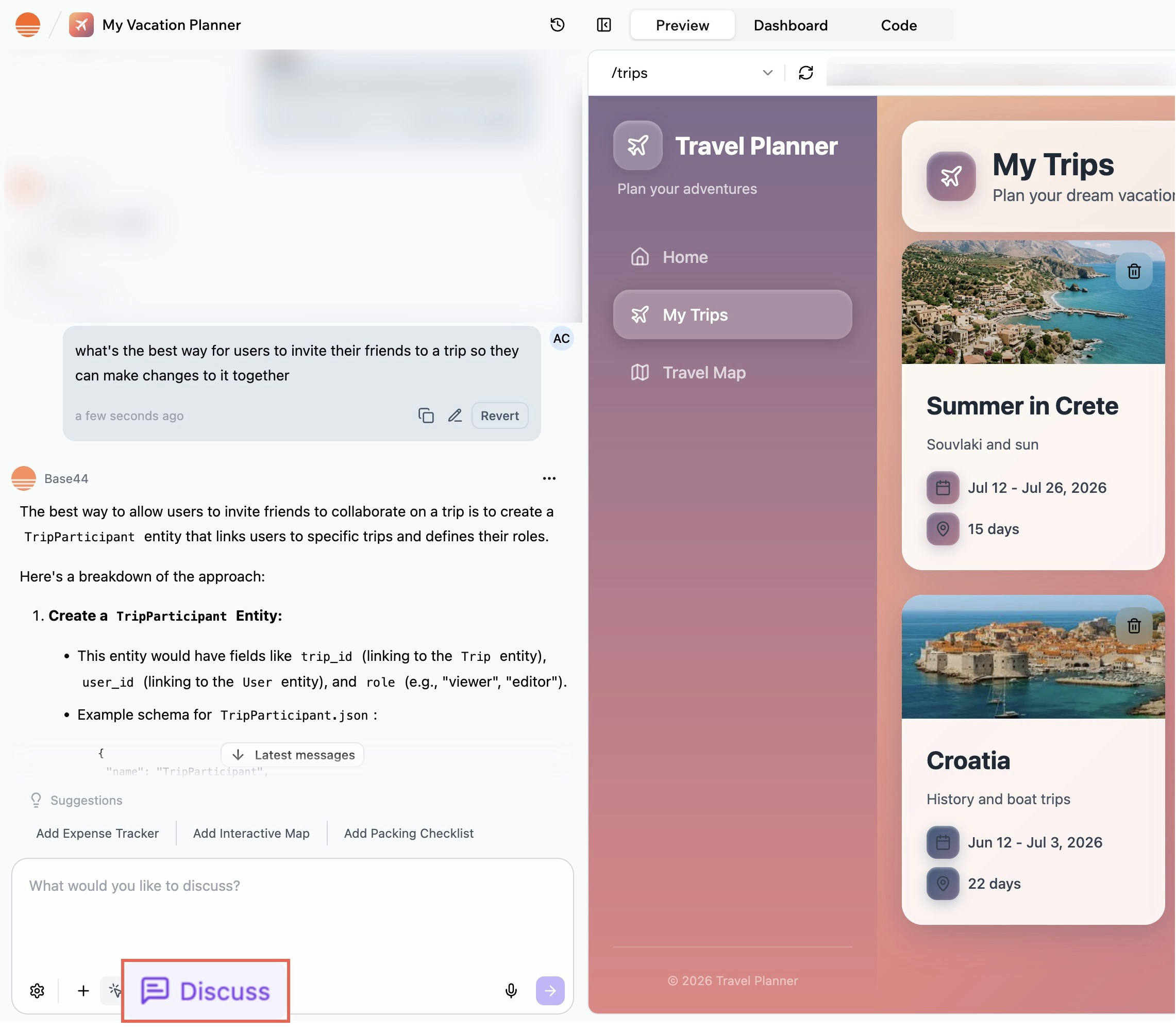
Using Discuss mode in Base44
Edit mode
Use Edit mode to make changes to the design of your app. You can do it manually or ask the AI to make the changes for you. Your edits save automatically as you work. You can undo and redo up to 50 steps within the same visual edit session using the undo/redo buttons at the top of the editor, and your edits remain through preview reloads. If you try to leave with unsaved changes, your browser warns you before you go. Your edits also appear in Version History, so you can restore a previous set of manual edits at any time. To make changes to the design of your app:- Go to the AI chat in your app editor.
- Click Edit.
- Make changes to the design:
- Manually: Select an element in your app preview to make the changes directly. For example, you can change background colors, text colors, or spacing. You can also quickly access the element’s code to make changes, adjust tailwind classes directly to fine-tune spacing, typography, layout, and responsiveness, or remove the selected element or section with the Delete icon in the Edit toolbar. This method does not use credits.
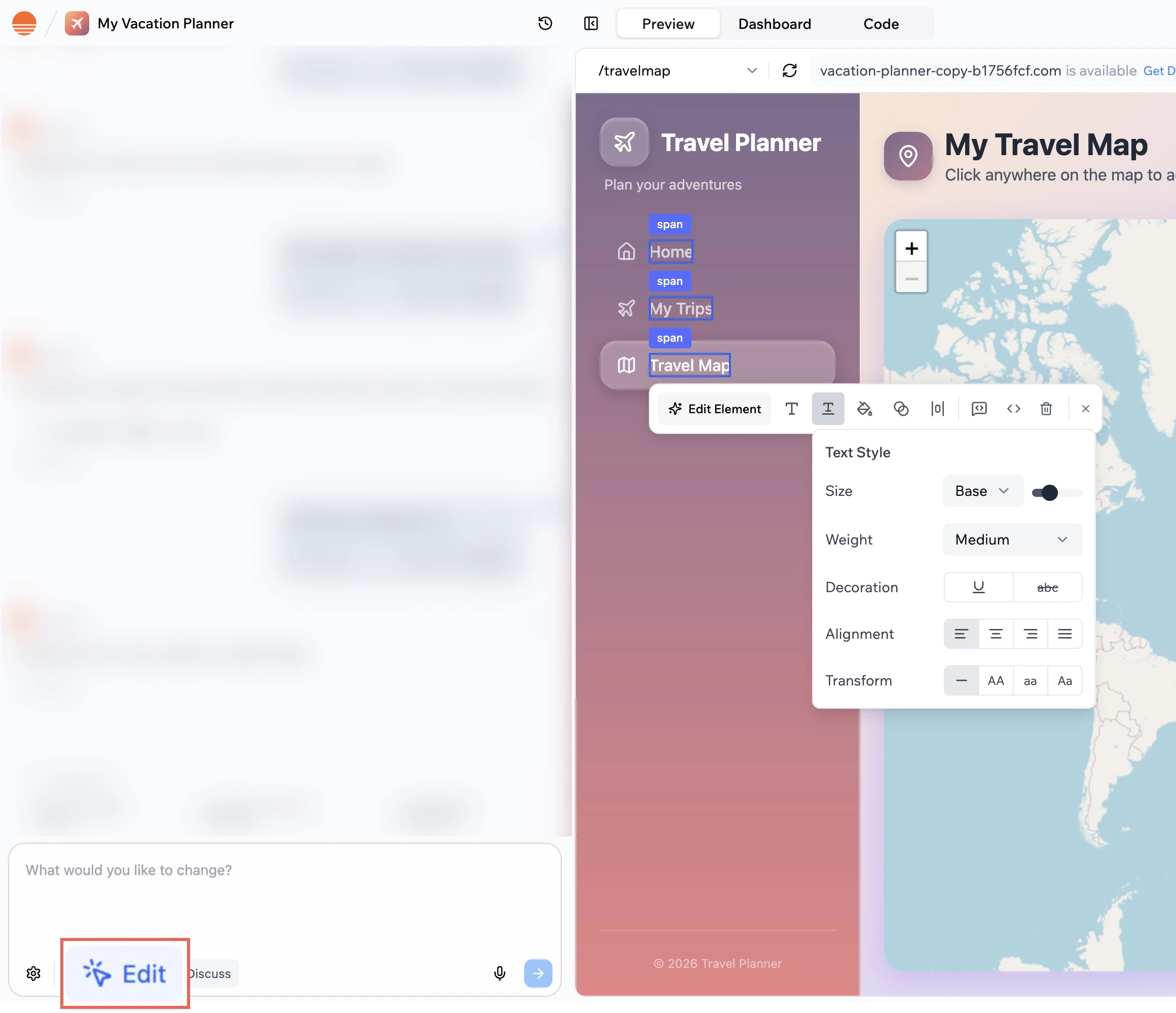
Using Edit mode to make design changes in Base44
- Using the AI chat: Select an element in the app preview and then click Edit Element. Write what you want to change about the element and the AI will take care of it. This method uses message credits. The number of credits depends on the size and complexity of the change.

Editing a specific element using the AI chat
- Manually: Select an element in your app preview to make the changes directly. For example, you can change background colors, text colors, or spacing. You can also quickly access the element’s code to make changes, adjust tailwind classes directly to fine-tune spacing, typography, layout, and responsiveness, or remove the selected element or section with the Delete icon in the Edit toolbar. This method does not use credits.


Queuing messages in the chat
When the AI chat is already working on a prompt, you do not need to wait before asking something else. You can keep typing, add more prompts, and attach files. The AI chat adds them to a message queue and sends them one by one as each response finishes.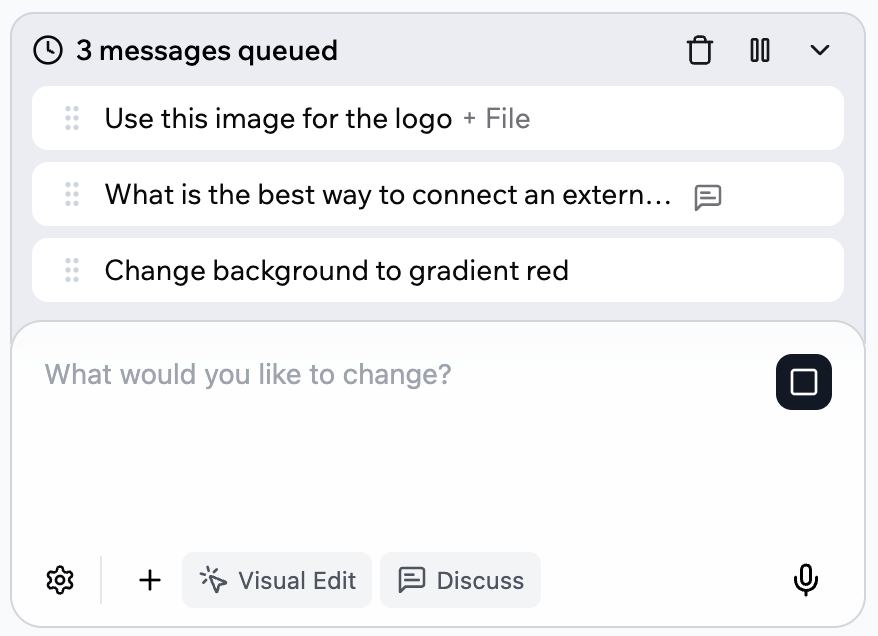
Queued messages waiting to run while the AI finishes the current prompt
- The queue appears above the chat input and shows all pending prompts in the order they will run.
- You can queue up to 7 messages at once.
- Queued messages do not send if you close the app editor. When you reopen the editor, any queued messages will resume.
Customizing the AI chat
You can tailor how the AI behaves and set custom controls.Choosing your AI model
Choose a model manually when you want more control. Each model brings unique strengths, so you can pick the best fit for your prompt. You can choose your model from your first prompt, or change it at any time while building. Expand an option below to see how.From your first prompt
From your first prompt
- On the Base44 homepage, below the prompt box, click the model selector.
- Select the model you want, or keep Automatic.
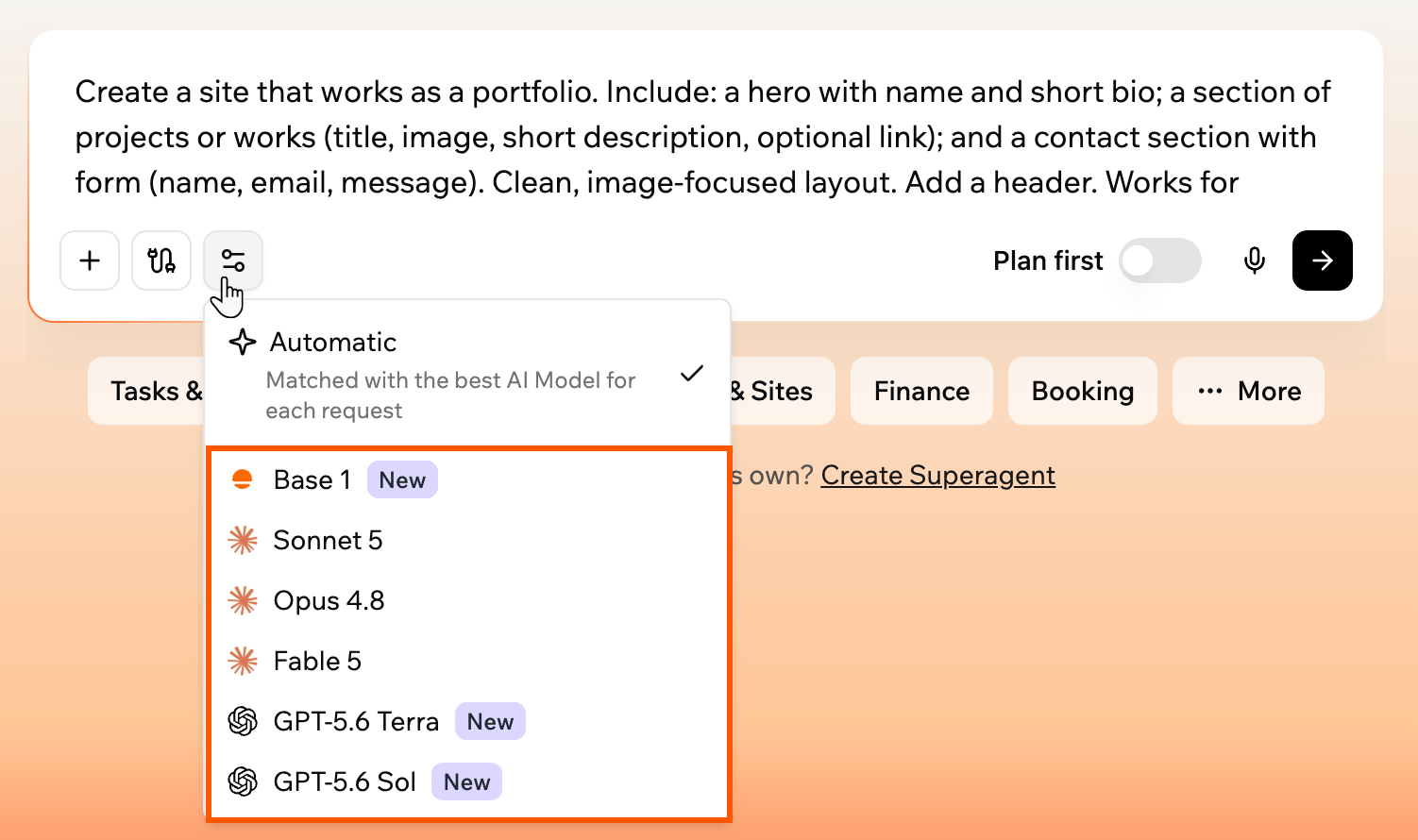
Choosing an AI model from your first prompt
While building
While building
- Go to your app editor.
- Click the Settings icon at the bottom of the chat.
- Click AI Model.
- Select the model you want to use, or keep Automatic to let Base44 pick the best model for each request.
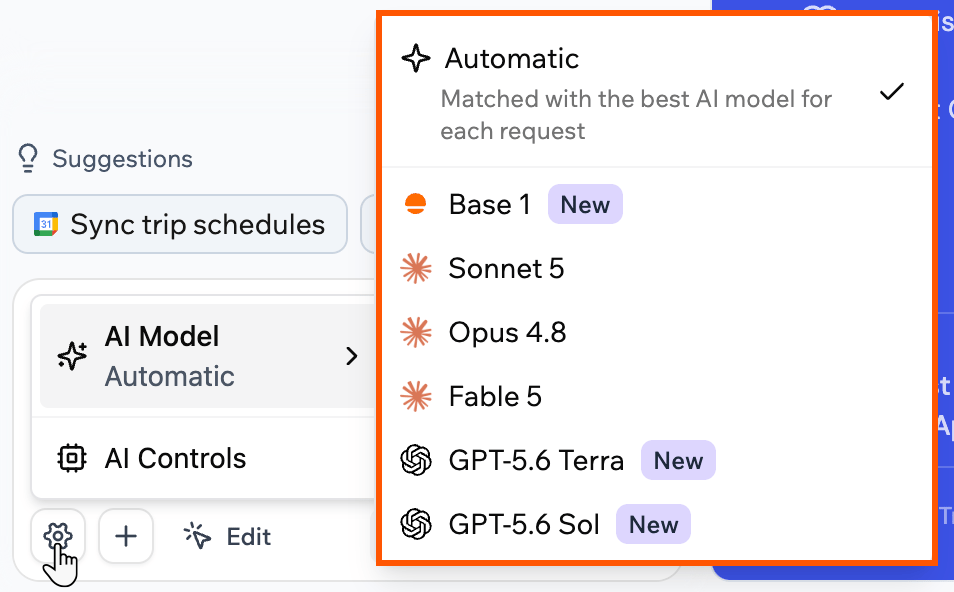
Choosing an AI model in the app editor
Available models
- Base 1: Base44’s first in-house model, trained on real building patterns from across the platform. A well-rounded, general-purpose choice for both everyday building and conversation.
- Sonnet 5: A well-balanced choice for day-to-day building, writing, refactoring, and troubleshooting, with a strong mix of quality and speed.
- Opus 4.8: The most advanced reasoning model, built for the hardest problems. Use it for complex multi-step logic, intricate architecture decisions, and edge cases where you need the highest level of accuracy.
- Fable 5: Great for complex, multi-step builds and detailed debugging, when you want thorough, high-quality results.
- GPT-5.5: A strong choice for complex reasoning and multi-step planning, with improved accuracy and consistency across large or evolving projects.
- GPT-5.6 Terra: A cost-efficient GPT-5.6 option for complex reasoning and multi-step planning, at a lower credit cost.
- GPT-5.6 Sol: The most capable GPT-5.6 option, for the hardest reasoning and large, evolving projects. Uses more credits.
Setting AI controls
AI controls let you define how the AI interacts with your app. They help you set consistent rules and protect important areas from accidental edits. Click the Settings icon at the bottom of the chat, then select AI Controls to open the panel:- Custom Instructions: Add default guidance for every AI interaction, such as tone, design standards, or preferred behavior.
- Freeze Files: Lock specific files or entities so the AI does not modify them.
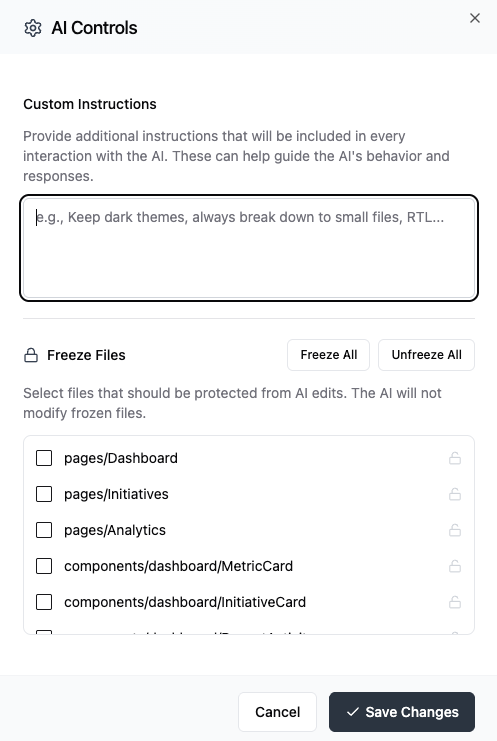
Reverting changes
Experiment freely and try new ideas, knowing you can always undo your changes at any time. You can roll your app back to a specific prompt, restore a previous version into the editor, or publish a previous version directly from Version History without changing what you are currently working on.Reverting a specific prompt
Hover over the relevant message in your chat history and click the Revert icon under it to roll your app back to the state it was in just before that change. Any changes made after that point are also undone, so you can quickly return to an earlier version of your app. If you want to change what you asked instead of just undoing it, click the Edit icon on that earlier message. The chat opens an Edit this message and resend panel. When you resend, Base44 reverts any changes made after that message and then applies your updated request.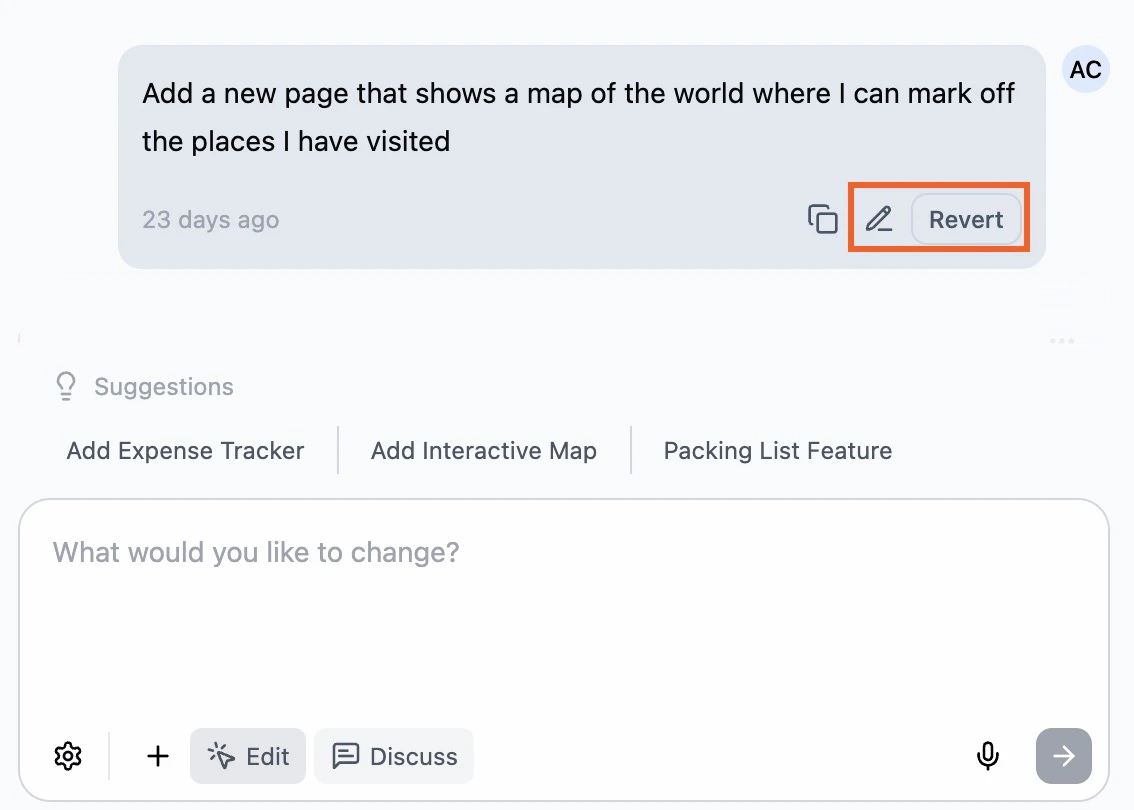
Revert and edit options under a message in the Base44 AI chat
Restoring or publishing a previous version
Click the Version History icon at the top of the chat to open your version list. From there you can preview versions, publish a previous version without changing your current draft, revert your editor to an older version, view the code, or jump back to the chat message that created that version.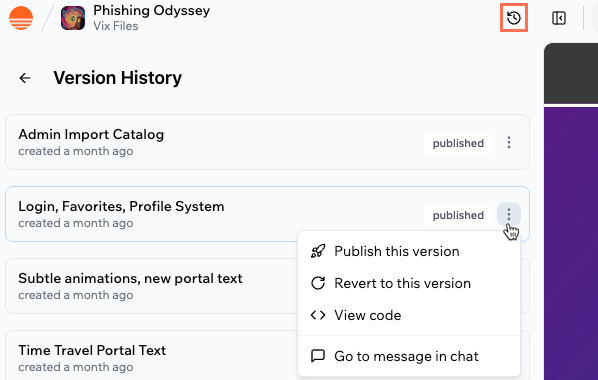
- Publish this version: Publish this version to your live app while keeping your current draft open in the editor so you can keep working.
- Revert to this version: Replace your current draft in the app editor with this version.
- View code: Open the code for this version.
- Go to message in chat: Jump to the chat message that created this version.
FAQs
Click a question below to learn more about AI chat modes and controls.How do I preview my app in full screen?
How do I preview my app in full screen?

What happens when there's a code error in my app preview?
What happens when there's a code error in my app preview?
How can I fix my app if it freezes after an AI action?
How can I fix my app if it freezes after an AI action?
- Refresh the page to reload your latest working version.
- Clear your browser cache and reload your app to remove any stored conflicts.
- Try a private window or another browser to rule out extension conflicts.
- Disable browser extensions temporarily if the issue persists.
- Check your credits and plan limits, since running out of credits can interrupt AI actions.
- Revert the last AI action in the chat by clicking the Revert icon under that message, or use Version History to roll back to a stable version.
Can I request credit refunds for AI mistakes?
Can I request credit refunds for AI mistakes?
What can the Base44 agentic AI do with its tools?
What can the Base44 agentic AI do with its tools?
- Read, create, update, and delete records in your app’s database. It can filter, sort, paginate, or update or delete in bulk. For example, add test people, mark old messages as read, or remove expired records.
- Perform web searches to find relevant documentation or features. This works like a search engine with relevant pages, titles, and descriptions.
- Fetch website data from any URL. Retrieve markdown or HTML, for example to scrape documentation or get live page content.
- Smart file search. Quickly find files or code snippets needed for your workflow.
- Read the contents of any project file before editing. This is useful for reviewing your app’s code structure.
- Modify files in your project. Edit pages, components, entities, functions, or layouts, and support targeted partial edits. For example, fix bugs, add features, or update styling.
- Inspect logs and console output to help with debugging or understanding errors.
- Set or update environment variables and secrets as needed. For example, add or update API keys like
OPENAI_API_KEYorSTRIPE_SECRET_KEY.
Are there things the Base44 agentic AI cannot do?
Are there things the Base44 agentic AI cannot do?
How is the time zone determined or managed in the builder?
How is the time zone determined or managed in the builder?
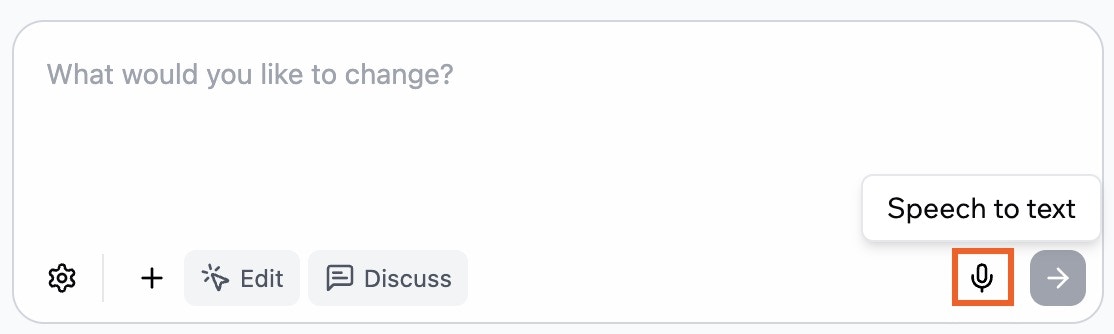
Can I speak to the AI chat instead of typing?
Can I speak to the AI chat instead of typing?
What should I do if AI chat gets stuck or cannot revert changes?
What should I do if AI chat gets stuck or cannot revert changes?
- Use Version History or Revert under a previous message to safely undo actions.
- Unstick a frozen prompt or stop button.
- Get help if the chat panel is completely unresponsive.
How does automatic model selection work?
How does automatic model selection work?
- For small visual or copy tweaks, it chooses fast, efficient models that optimize for speed and responsiveness.
- For larger architectural changes or data flows, it uses deeper reasoning models that can plan across files, entities, and logic.
- When something fails or runs into an error, it can switch strategies or models to recover and try again.